Thursday, May 31, 2012

How Physical Is Eternity?

Scripture says that the lion will lie down with the lamb. Is this to be understood literally or symbolically? Does it refer to the present time, the millennium, or all eternity? Does this make a difference? Now the emphasis of Scripture is not on going to heaven, but on the resurrection (1 Corinthians 15:20-28; Philippians 3:20,21; 1 Thessalonians 4:13-18). The Scripture does say that, for those who die in Christ, their souls go to be with Him (Philippians 1:21-26; Luke 16:19-31; Ecclesiastes 12:7). But this seems to be more of a waiting time in preparation for the real event.  If we see the main emphasis as being on our departing, it produces a more other-worldly outlook on life. We tend, following the Greek philosopher, to see physical things as an encumbrance we need to escape. But Scripture says that God created the physical world (Genesis 1:1; John 1:3; Psalms 104:24-30) and created us to be a union of spirit and body (Genesis 2:7; 1 Kings 17:21,22; Matthew 10:28). This is what we are meant to be. Now there is a delicate balance here, as we live in a fallen world and cannot simply accept things as they are (Romans 8:19-23; 1 John 2:15-17; James 4:4). But we are not allowed to reject physical things as simply evil (Colossians 2:20-23; 1 Timothy 4:4,5; Titus 1:15). Our goal is a new heaven and a new earth (Revelation 21:1-4; 2 Peter 3:10-13; Isaiah 65:17), not a bodiless spiritual existence.

The exact relationship of this realm to our present reality is hard to understand. It is likened to the relationship of seed to plant (1 Corinthians 15:35-49). (By a spiritual body I do not understand an immaterial body, but a body free from the effects of sin.) The Lord Jesus' body after the resurrection had interesting characteristics. He could appear and disappear suddenly and enter locked rooms, but He was touched and ate food (Luke 24:13-43; John 20:19-29; 21:4-13). We do not really know what it will be like, but it does not seem an immaterial existence. Will there, then, be lions and lambs in eternity? I am not dogmatic one way or the other, but I do not reject it out of hand. I do not see any basis for interpreting such passages as referring to the present time, and it seems stretching any possible symbolism in the passage to do so. Nor do I see that such things can be simply shunted aside to the millennium. The idea of an end to war that is connected with these types of passages does not fit with a millennium that will end in a war (Isaiah 2:1-4; 11:1-9; Micah 4:1-5 compare Revelation 20:7-10). (It is not my purpose here to deal with the question of whether there is or is not a millennium, merely to remove it as a red herring.) The exact nature of the eternal state is difficult to discern, but we should be careful of rejecting automatically it having any physical aspect to it.

Wednesday, May 30, 2012

Who Is in Control?

Re-Posted from "Meditations of a Charismatic Calvinist Who Does Not Speak in Tongues"

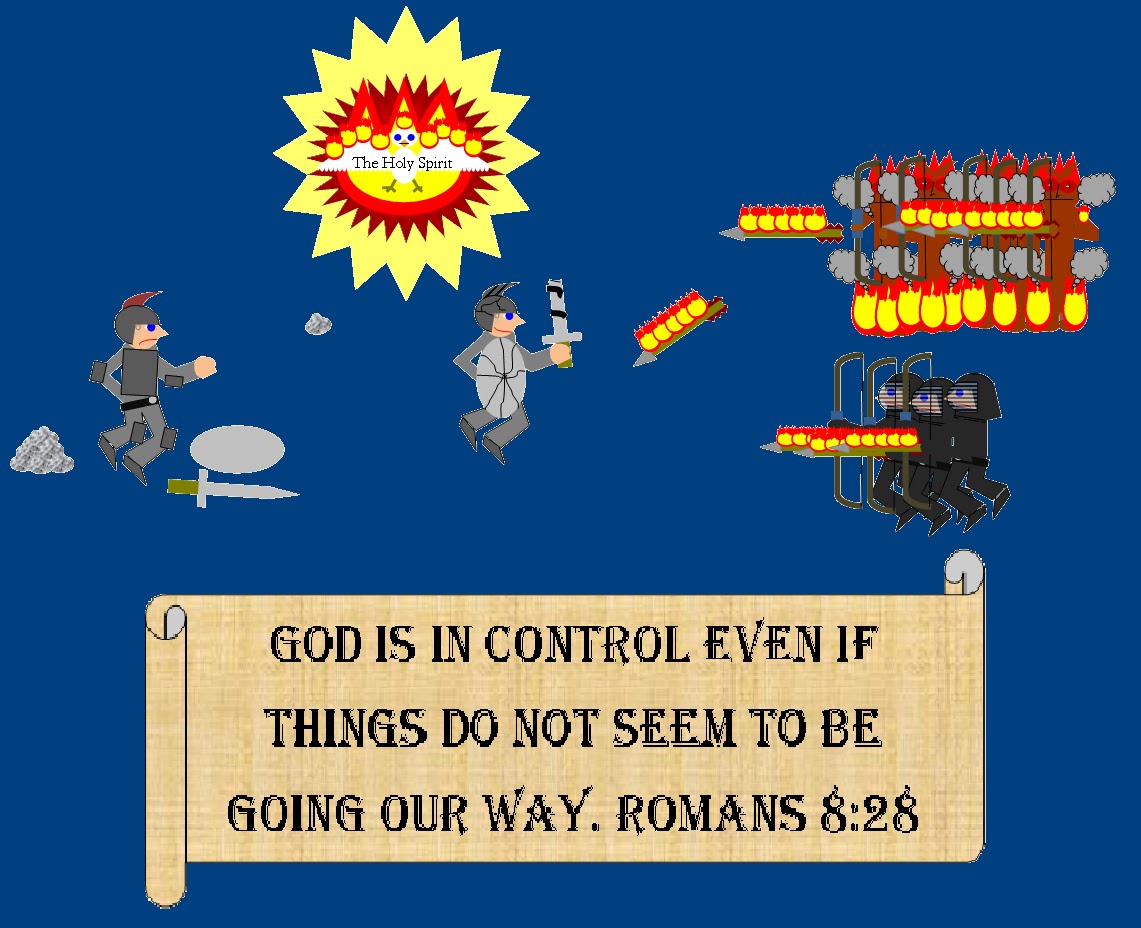
Does the world sometimes seem out of control? Does your life sometimes seem out of control? But more importantly, who should really be in control? Too often the answer we would prefer, if we really examine ourselves, is that we want to be in control ourselves. But as we look at the world around us, especially from the Christian point of view, it seems to be careening out of control. But God says that He is in control (Ephesians 1:11; Romans 8:28; Isaiah 46:10). Further, He says He is at work building His church (Matthew 16:18; 1 Corinthians 3:6,7; Colossians 2:19). He is also at work in our lives to accomplish His purposes (Ephesians 2:10; 2 Corinthians 3:5,6; Colossians 1:28,29). The problem is that this does not always involve what we want and what makes us comfortable. Sometimes it means going through times of hardship (John 16:33; Acts 14:22; 2 Corinthians 4:17,18). But we need to trust Christ to bring us through the difficulties, both in ourselves and in the world around us. Even if what happens is not what we want.

Tuesday, May 29, 2012

What Is Faith?

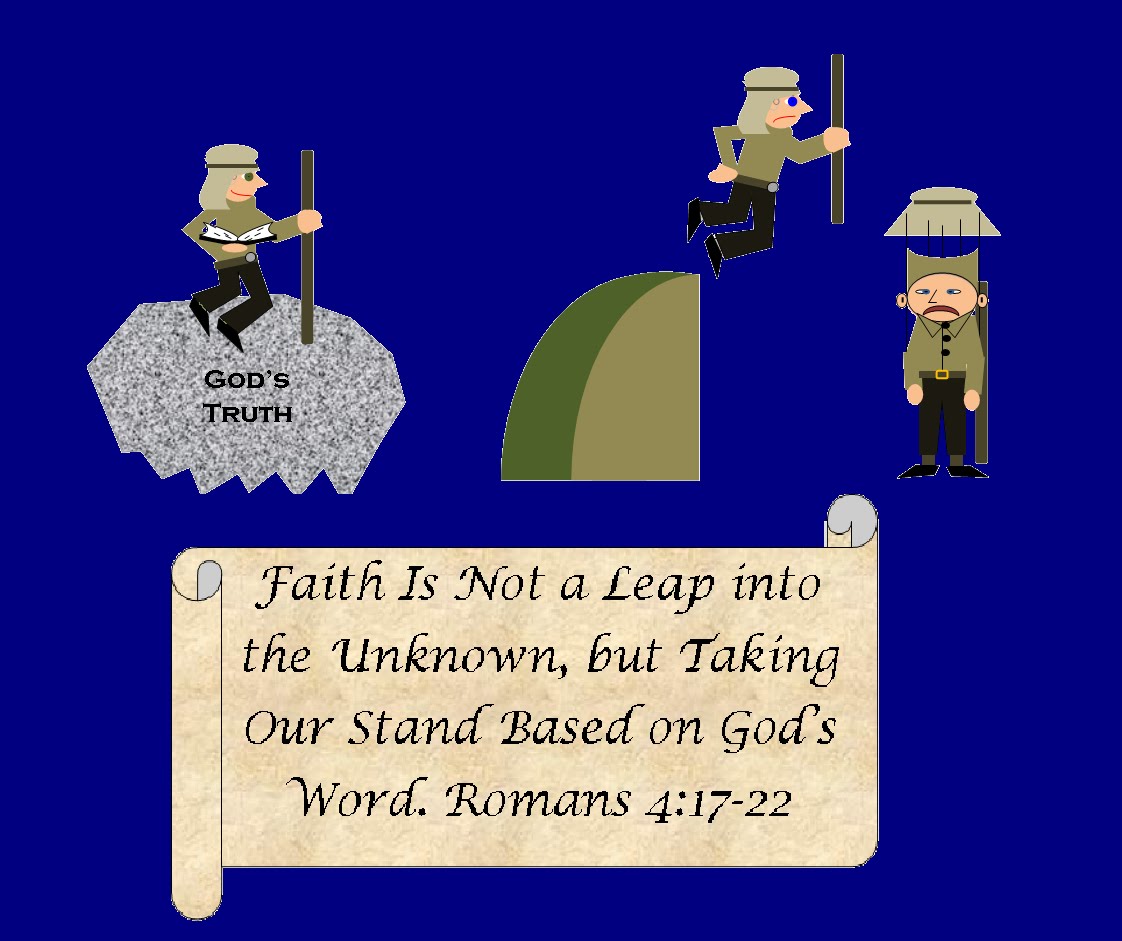
There are perhaps few more variously understood words in the language than faith. What does the Bible mean by faith, and how does that differ from the various other ideas that exist about it?. Scripturally, faith is believing the promises of God (Romans 4:16-22; Hebrews 11:13-16; 6:13-20). Because of this, faith is contrasted with sight, which is the possession of the thing promised (2 Corinthians 5:7; 4:17,18; Hebrews 11:1). This is not opposed to reason, but to our initial reaction to circumstances (Hebrews 11:24-27; John 20:26-29). One of the fallacious assumptions involved here is that we are basically rational creatures, who will always follow the most reasonable and logical course of action. The truth is, we are all too often driven by our feelings and desires. And this is why, from a Christian perspective, faith is a virtue. I am convinced there are good reasons for believing Christianity is true, nor do I see it as a virtue to believe something you think untrue in the teeth of reason. As for the genuine intellectual challenges, these must be met and dealt with. But when I am facing trials. Or I am looked down on for my faith, or even just feel out of place among those who do not share my beliefs. Or when I would find it convenient not to be encumbered with these Christian moral scruples in a particular situation. That is when faith comes in. It continues to trust and follow God in these types of circumstances (Proverbs 3:5,6; Hebrews 1:6; Psalms 46:10).

This faith may involve two different, though not necessarily incompatible, ideas. It may involve trusting God for deliverance (Matthew 8:5-13; 9:27-31; 17:14-21). Or it may involve trusting God even if there is not immediate deliverance (2 Corinthians 12:7-10; Hebrews 11:35-40; Daniel 3:16-18). It is not simply faith in our faith, but faith in a Person who works everything according to His will (Ephesians 1:11; Romans 8:28; Isaiah 43:13). But it is trusting in Him, whether or not He immediately delivers us from the situation. It builds our character in the long run, as we trust in Him (James 1:2-4; Matthew 6:33; Isaiah 40:31). Now basic to this is our faith in Him for salvation (Ephesians 2:8,9; Romans 4:4,5; Philippians 3:9). We do not now see eternal life or the resurrection or the kingdom of God fully realized on earth (John 14:1-3; Romans 8:24,25; 2 Peter 3:8-13), but we put our faith in God for it. Therefore, our faith is not a mere knowledge of the facts (even demons have that: James 2:19), but a trust in God that He will fulfill His promises. Therefore, faith is not some sort of a leap against reason. It is not positive thinking or a way to manipulate God. Nor is it mere adherence to a set of facts (though this may be a necessary preliminary). It is reliance on God, that He is truthful and will do what He has said (Titus 1:2; John 17:17; Romans 3:4).

Monday, May 28, 2012

A Touch of Humor - Instruction

What is the best approach to instructing people? Does it depend on the subject and the people?

Saturday, May 26, 2012

Old Erich Proverb - Defending God

Our job is not to defend God; He is able to take care of Himself.

Friday, May 25, 2012

A Voice from the Past - Martin Luther

When the Law accuses and sin terrifies you, and you do not feel anything except the wrath and judgment of God, do not despair on that account. But "take the armor of God, the shield of faith, the helmet of hope, and the sword of the Spirit" (Eph. 6:13, 16, 17); and find out by experience what a good and brave warrior you are. By faith take hold of Christ, the Lord of the Law and of sin and of everything that accompanies them. When you believe in Him, you are justified -- something that your reason and the consciousness of your heart do not tell you amid your temptation, but only the Word of God.

Martin Luther, 1483-1546, Commentary on Galatians 1535, 5:5 (Luther's Works, Vol. 27, edited and translated by Jaroslav Pelikan, 1964, Concordia Press, p.26)

What does this say about dealing with doubt?

Thursday, May 24, 2012

Is Christianity Against Learning?

Is Christianity against learning? This is a claim that is often made, with the Middle Ages being pointed to as proof of this thesis. The claim is that all learning perished and that this was the result of Christian dominance. Now this is an exaggeration. There continued to be scientific and technological advances through the Middle Ages. But to the extent it was true, the obvious culprit was the collapse of the Roman Empire. When the central government collapses and invaders overrun the existing culture, looting and pillaging, it is not surprising if a large degree of learning is lost. And it was the Christian church that worked to preserve literacy and learning. If anything, they had perhaps too high a view of learning and too high a view of antiquity. As a result, they preserved many books that did not fit the Christian view of the world and tried to reconcile them together into one system. Later, when order was restored, the Middle Ages produced many scholars who were interested, not only in studying theology, but in the various aspects of the natural world. The university was also created to promote higher education.

However, the classical Greek learning preserved in the Middle Ages had a problem. Its emphasis was on attempting to understand nature by abstract reasoning. In contrast, modern science has taken the more empirical approach of observation and experimentation. This is the distinction between a person who contemplates the universe in his study and one who is actively involved in the world.  I am convinced that the transition took place as a result of Christianity. Christianity approaches proof on a more empirical basis, appealing to eyewitnesses, rather than logical deductions. It also worships a God who directly created the world. Further, when God became a man, He became a carpenter, a man who works with his hands. But this new idea took time to be accepted against the predominant respect for entrenched Greek learning. It did not help that Aristotelian philosophy had become entwined with Roman Catholic theology and had been cemented there by the Protestant Reformation. It is therefore not surprising that, when Galileo challenged the established beliefs, he met strong resistance.

As for other martyrs for science, they were not. The issue with Columbus was not whether the world was round (he wrote that he had always read the world was a sphere) but whether it was smaller than generally thought. He was wrong. Bruno and Servetus were martyrs to their theological opinions, not to science. Now it does need to be noted that Christianity is a specific belief system and opposes contrary systems. Therefore, a person who holds to, for instance, atheistic  materialism may claim that Christianity is against learning because it is opposed to their belief. As an argument, this is merely circular reasoning. Therefore, there is no objective basis for saying Christianity is in principle opposed to learning.