Saturday, January 31, 2015
Old Erich Proverb - Walls
We work hard to build walls between us and other people, but God is the great Wall-Breaker.

Friday, January 30, 2015
A Voice from the Past - Calvin
Therefore, let us hear no more of a proportion between our ability and the divine precepts, as if the Lord had accommodated the standard of justice which he was to give in the law to our feeble capacities. We should rather gather from the promises how ill provided we are, having in everything so much need of grace.
John Calvin, 1509-1564, Institutes of the Christian Religion, Book II, Chapter V, 7 (translated by Henry Beveridge, Wm. B. Eerdmans Publishing Co., 1975, Vol. 1, p. 279)
How do we avoid trusting in our ability rather than God's promises? What things would tend to discourage us from doing so?
John Calvin, 1509-1564, Institutes of the Christian Religion, Book II, Chapter V, 7 (translated by Henry Beveridge, Wm. B. Eerdmans Publishing Co., 1975, Vol. 1, p. 279)
How do we avoid trusting in our ability rather than God's promises? What things would tend to discourage us from doing so?
Thursday, January 29, 2015
Dancing with Fairies

What then about fairies? There have always been mysterious things observed along the edges of human life. In the old days it was fairies, leprechauns, and goblins. In modern times it is UFOs, Bigfoot, and the Loch Ness Monster. Ghosts seem to be perennial. (Santa Claus, the Easter Bunny, and the Tooth Fairy are in a different category, being simply games for children. I have empirical evidence that they are not real.) I am high skeptical of any of these being genuine. But I still feel they need some explanation. In terms of UFOs, I like the Klass plasma hypothesis, that what is observed is some naturally occurring form of plasma. It would explain why they are observed by otherwise reliable observers, but do not act as we would expect alien spacecraft to. I sometimes wonder if in earlier times people saw moving lights and imagined there was a person inside. But whatever they are, hallucinations, natural phenomena, real, or even demonic manifestations, I would like considerably more evidence before believing any of these are what they are claimed to be. However, if such evidence were forthcoming, I am convinced that science would find a way to integrate such things into the natural universe, even fairies. It would ask what they were made of and where they came from and expect to find answers. I am not expecting this to happen because I do not believe fairies are real, but the problem is the lack of solid evidence. What this has to do with the existence of God, who was announced publicly by prophets and became a man to pay for our sins in the open light of history, is not at all clear. You can disbelieve in both, but I see no real analogy.
Part of the problem here is a misunderstanding of monotheism. There are two types of monotheism. One wants one God who is a minimal God that does almost nothing. The other believes in one God who is an absolute God and brooks no equals. The God of Christianity is the second type. He is not the last limited remnant of the supernatural, after all the rest are refuted. He is the Sovereign who controls all things, leaving no place for lesser gods, or even fairies.
Wednesday, January 28, 2015

Tuesday, January 27, 2015
United We Stand

But too often we base our unity on other things. We can claim we have to come to God through being part of a particular organization rather than directly through Christ (1 Timothy 2:5; John 14:6; Acts 4:12). Now God's people are called to be organized (Ephesians 4:11-16; Hebrews 13:17; Titus 1:5). But the organization should serve the people, not the other way around (Matthew 20:25-28; 28:18-20; 1 Peter 5:1-4). Now the message of Christ requires us to hold to certain basic truths (Jude 3; Romans 16:17-20; 1 John 4:1-6). But we can divide over every detail, forgetting that we do not have all the answers (1 Corinthians 3:18; 8:1-3; Philippians 2:1-4). We are also told that putting our faith in Christ results in a changed life (Titus 2:11-14; 2 Corinthians 3:18; Ephesians 2:10). But it is easy to erect a structure of dubious ethical requirements to distinguish ourselves from others (Romans 14:1-12; Matthew 15:7-9; 23:23-28). It is important to base our unity on the right grounds.
But if we do not have a solid basis for our unity, we can, almost by default, base it on something that lacks any clear definition. This can seem broad-minded, but can often have the opposite effect. Those who see the unity of the church as based in Christ have a definite idea of what unity is based on and know where the boundaries are. But it is often those who have no clear idea what their faith is based on who can make a big deal out of externals. They can divide over names or outward behaviors because they have no clear idea of what the issues are. It is the individuals who clearly understand what they believe who can recognize those who agree, even if they use different words, and see where they disagree with others, if they do. But those with a superficial knowledge are more likely to be impressed by catch-phrases and procedures. And many of the divisions in church are over methods or personalities or even atmosphere. I would therefore conclude that one of the most important factors for maintaining unity in the Christian church is remembering what and Who we are about. Or we will be forever dividing over shadows rather than substance.
Monday, January 26, 2015
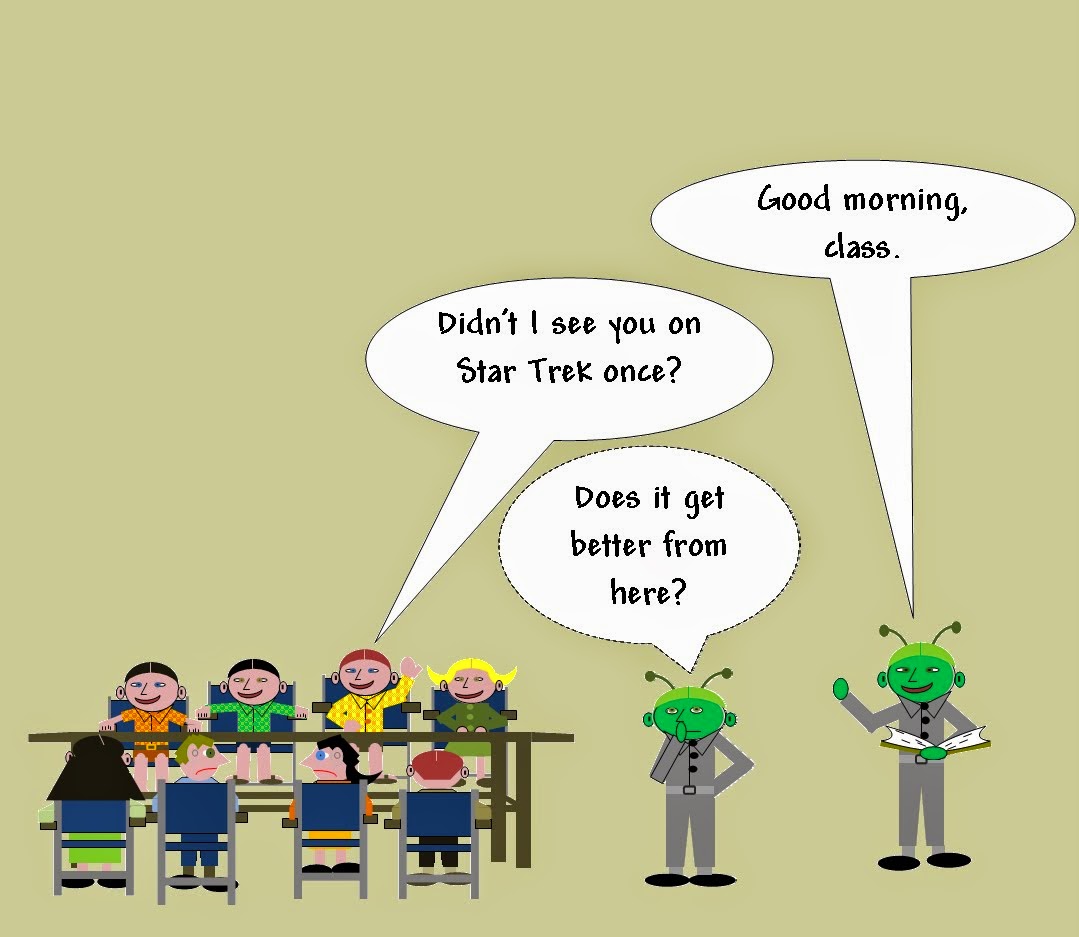
A Touch of Humor - The Introduction
Saturday, January 24, 2015
Subscribe to:
Posts (Atom)