Tuesday, May 18, 2010

Thursday, May 13, 2010
How Primitive Was Rome?

It is claimed that Christianity was believed because it originated in a primitive age. Now the Roman Empire did not have our technological advances. But it seems unlikely that one's level of technology protects from credulity. Looking at what is found in supermarket tabloids and certain emails, I doubt we are immune from false information. Technology seems to mean that both bad and good information is carried at a faster speed. But otherwise were the Romans more primitive than we are?
They had philosophies that claimed to explain how the world worked. One of the earliest criticisms of Christianity was by Galen, who said that miracles were contrary to natural law. Granted, their understanding of the laws was different from ours, but they had the concept. The idea that people believed in miracles because they did not know the laws of nature does not stand up to examination. The very idea of a miracle presupposes that nature is governed by orderly laws. Otherwise you cannot tell a miracle from a normal event. The real question is whether there is Someone beyond nature who can intervene to produce miracles. This issue has not changed at all since Galen. Now they had some opinions we would regard as fantastic. It is difficult to be sure now how seriously Apuleius took his stories about witches or Philostratus his about vampires, unicorns, and dragons. But today we have beliefs in ghosts, space aliens, Bigfoot, and the Loch Ness Monster. Whether there is any factual basis for any of these claims may be argued, but times have not changed much.
The Romans were cynical of their religious beliefs. Many simply went through the motions without taking them seriously. They also resorted to allegorism to reinterpret their traditional stories . Lucian and Juvenal even wrote satires making fun of the Roman deities. Another early criticism of Christians, voiced by Pliny the Younger, was that they were obstinate and would not simply go along with the established observances. There were those (for example Lucretius) who held that the gods were totally indifferent to human affairs and that everything in the world came into existence by chance. Further, the Romans were known for their moral decadence and carried it to a point even beyond ours. While there were those who opposed it, they were fighting a losing battle. There were at that time certain extreme religious cults (called mystery religions). We have the same today. One suspects there is something about the naturalistic view of the world that causes people to revolt and embrace the opposite extreme.
This brings us back to the reason for the spread of Christianity. I am convinced the best explanation is that the tomb was empty. Also, the Christian message that God Himself had invaded history and paid the penalty for sin was unique, even among the religious options of the time. But whatever the explanation is, the idea that Christianity originated in a primitive time does not fit the facts.
Tuesday, May 11, 2010
Go and Make Disciples
 Christ told us to make disciples (Matthew 28:19), but what does that mean? "Disciple" means "learner," and in the original context it referred to the follower of a teacher, someone who lived with him and learned from him. But what does it mean in a Christian context? Many of the passages in Scripture refer to the Twelve, though it is not always clear if others are included. But Scripture speaks of other disciples, too (Acts 6:1,2; 9:36; 11:29). The logical conclusion is that those who are or profess to be Christians are Christ's disciples (Acts 11:26; 9:1; 6:7). Joseph of Arimathea, who before the crucifixion was unwilling to declare himself publicly, was considered a disciple (Matthew 27:57). Even the crowd that met Jesus on His way into Jerusalem on Palm Sunday were called disciples (Luke 19:37,39). Those who walked no more with Him when confronted with difficult gospel truth were called disciples (John 6:66).
However, Scripture exhorts us to consider the price of being a disciple (Matthew 8:19-21; Luke 14:26-35; Mark8:34-38). Being a disciple results in a new manner of life (John 8:31; 13:35;15:8; Matthew 28:19,20) and ultimately in becoming like Christ (John 13:13-17; Luke 6:40: Matthew 10:24,25). Therefore, we should not distinguish between those Christians who are or are not disciples , but ask whether we are living like we should as disciples. This makes a difference because it makes discipleship a process we grow in (Hebrews 5:14; 2 Corinthians 3:18; Colossians 2:19), rather then something we either are or are not.
The current emphasis on discipleship is right in saying that we should not just make converts but encourage them to grow in Christ (Ephesians 4:13-15; Colossians 1:28,29; Philippians 3:12-15; Hebrews 12:1,2). It also avoids putting the entire burden of ministering to others on a few leaders (Ephesians 4:12; Romans 12:6-8; 1 Peter 4:10). It can sometimes become a one-size-fits-all approach, ignoring the differences in the members of the body of Christ (1 Corinthians 12:12-25; Romans 12:3-5; 1 Peter 4:11). But we especially need to avoid the tendency to judge if others are disciples (Romans 14:4; 1 Corinthians 4:3-5; James 4:11,12). We are to correct specific sins with gentleness (Galatians 6:1; 2 Timothy 2:23-26; Matthew 18:15-17), but we are not the ultimate judge of another's spirituality. Also, there is a temptation to condense all the things Christ commanded us (Matthew 28:19,20; Acts 20:27; 2 Timothy 2:2; 3:16,17) into a simplified message of what is necessary to be a disciple. This results in young Christians being sent into the heat of the battle when they are not prepared. Admittedly, it is also possible to spend considerable time becoming prepared and never doing anything with it (Galatians 6:9,10; Romans 12:11; 1 John 3:18; James 1:27). The solution is being a lifelong disciple both in learning and in doing. Now obviously those in charge have to make decisions on who to train and put in leadership positions. But we should be careful not to label people spiritually.
Thursday, May 6, 2010
Identifing the Church
 What is the church, and how does it relate to the nation of Israel? Some see Israel as becoming the church. Others see them as two separate entities, not to be confused. Others say they are two different manifestations of one people of God. Now certain principles apply to both, such as salvation by grace through faith (Genesis 15:6;Romans 4:1-5; Psalms 32:1,2; Romans 4:6-9; Habakkuk 2:4; Romans 1:17). There are also differences between the two (Hebrews 10:1-10; Colossians 2:16-17; Mark 7:19). I would maintain that what changes and what does not should be based on what Scripture says, rather than on a preconceived concept . But that does not resolve all the issues.
We are baptized by the Spirit into the body of Christ (1 Corinthians 12:13), which is the church (Colossians 1:18). Now in Galatians 3:27, it says that those who have been baptized into Christ have put on Christ. Philippians 3:9 speaks of our being found in Him, having not our own righteousness but Christ's, which is the basis of our salvation (Romans 3:21-24). Therefore, the church is the assembly of those who are saved. But there are passages of Scripture which mention both the church (Matthew 16:18) and baptism by the Spirit as yet future (Acts 1:5). Now there is a change in the working of the Spirit between the Old and New Testaments (John 7:39; 14:17). But Scripture makes it clear that no one can be saved (John 3:5) or genuinely obey God (John15:7) without a work of God in their life. Nevertheless, there is a change, and the logical conclusion is that this change relates to salvation promised versus salvation accomplished (Romans 3:25, 26). If so, it must ultimately be applied to all who are promised salvation. I would therefore conclude that the church is the assembly of all believers of all ages after the time of Pentecost.
What, then, is the place of Israel? Now the initial response may be that in Christ there is neither Jew nor Greek, as all are one in Christ Jesus (Galatians 3:28-29). However, in this same passage it says there is neither male nor female, but elsewhere in Scripture there are distinctions made (Ephesians 5:21-33). Therefore, I conclude that unity in Christ does not obliterate temporal distinctions. Consequently, there could still be specific temporal promises to the nation of Israel. Now I would hold that there is a Scriptural basis for a restoration of the Jewish people (Romans 11) and that the references to being set aside can be referred to the specific generation of Christ's time (Matthew 21:43). This fits better with the grace of God, whose callings are not revocable (Romans 11:29). But others disagree, and I would write this off as a minor interpretative issue if it did not impact the more complicated issue of how to understand the prophecies of the Second Coming. It is beyond my purpose to deal with these details here, but they should be argued on their own merits, not on how they fit into a presupposed system.
Tuesday, May 4, 2010
Finding the Balance
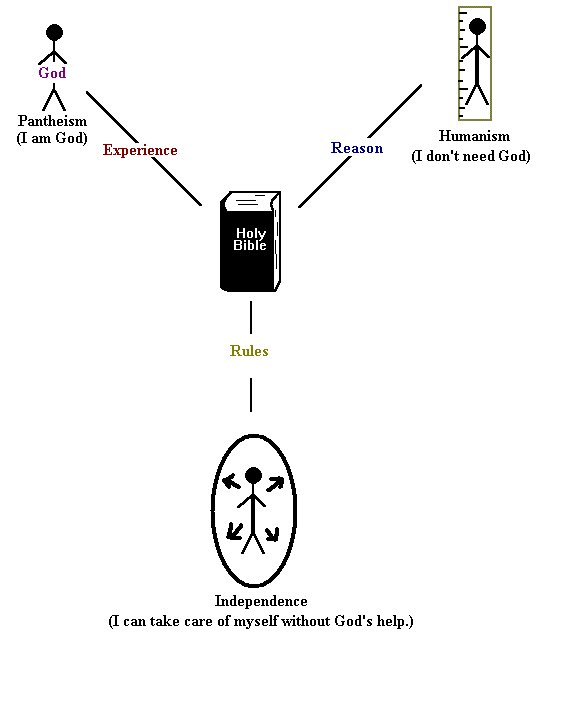 Human beings follow different paths to try to deal with their world. Our initial reaction to the world is that something is wrong with it. Pain and suffering are rampant. (Some philosophies may try to prove this is normal, but it needs proof.) Also, we see something is wrong with ourselves. We have definite goals for our behavior, and we come short. (Again, this may be explained away, but it requires explanation.) What is the solution?
Some see the solution in reason. If we figure it out, we can solve our problems. This is an uncommon approach today, perhaps because we have sought and failed to find our answers here. But there are intellectuals who persevere in this. It results in thinking the human mind is the measure of all things and can solve our problems without God's help. While it is rare today, some understand Christianity in light of this. They hold to their own ideas rather than what God said.
An alternative approach is to seek answers in experience. This can range from following immediate impulses to looking for a deep mystical experience. This results in making our experiences the test for everything and finding God (or whatever we put in His place) inside ourselves. But if we depend on experience, we can never be sure if we are experiencing God, the devil, or our own psychological quirks. Also, experience is notoriously fickle; it can come and go or require more and more to produce it. Christians can get involved in this, too, and can build their faith on experience.
Another option is living by the rules. If we find the right rules and enforce them, it will solve our difficulties. These rules need not involve morality; some professedly non-moral people adhere to a strict code of behavior. This results in being self-sufficient and believing we do not need help from anyone, including God. The problem is we fail to keep even our own rules. Also, apart from reason or experience it is difficult to know which rules to enforce. Christians, too, can follow this approach, becoming self-righteous and independent.
The real solution is found in Scripture and ultimately in the cross. It is here we find truth which is beyond our limited human reason (1 Corinthians 3:18). We learn we are sinners (Romans 3:23), living in a world under a curse (Romans 8:19-23). We also learn that God has sent His Son to pay the price for sin (Ephesians 1:7) so that we might be saved by trusting in Him (Romans 4:4,5). Based on this we can begin to understand truth (John 17:17). We can also experience God's peace and joy, which are rooted in knowing about God and His love for us (Romans 14:17). We can live disciplined lives in light of the grace of God (Hebrews 5:14). All of these are kept in balance by Scripture and the cross, where grace and righteousness meet (Psalms 85:10). But trusting in ourselves is destructive.
Thursday, April 29, 2010
Predestination and Evangelism

It is claimed that if God chooses who will be saved (Ephesians 1:4), it negates the need for preaching the gospel (Matthew 28:18-20). Scripture teaches that God is in control of all things (Ephesians 1:11), but it also teaches us we have a responsibility to obey God's commands (John 14:21). This is beyond human comprehension (Romans 11:33), but much about God is beyond human comprehension. God's normal way of communicating His truth is through a human preacher (Romans 10:14), and we have the obligation to be involved in this (1 Peter 3:15). If God has chosen who will be saved, He will see they get the message. But we are the agents He uses to accomplish this. If we refuse, God will still accomplish His purpose, but we are responsible for our disobedience. This does do away with motivating people by explaining how people will go to hell if we do not evangelize. But the guilt-trip approach seems as likely to overwhelm as to motivate. Also, it makes people so driven they may use any method, no matter how questionable, to get the job done.
But it is claimed that belief in predestination historically has been opposed to evangelism. The Protestant Reformers, who held this teaching, worked to evangelize all of Europe. John Calvin smuggled preachers and Bibles into France, others preached God's grace at the risk of their life, and some, like William Tyndale, gave their lives. That Protestants did not immediately send missionaries to foreign lands is not surprising. They were embroiled with troubles at home, and control of the sea was in the hands of the Catholic countries of Spain and Portugal. Even when nominally Protestant nations gained control of the sea, they were frequently more interested in making money off their subjects than spreading the truth of God. But William Carey, who started the missionary movement, was a Calvinist.
Much has been made of the opposition from Calvinists to William Carey's missionary ambitions. But in Carey's pamphlet defending his position he never mentions Calvinism, even to correct misunderstandings of it. In fact, the main issues that Carey addresses were practical, such as, "where will we get the money?" and, "the natives will kill us." Note that Carey was not asking them to agree in theory to preaching the gospel in other lands, but to actually send people out as missionaries. As for the famous incident at the beginning of Carey's career where he was told to sit down by the leader in charge of the meeting, it is not absolutely clear what was said, but one version suggests that the objector thought that the only way the gospel could be preached in far-off countries would be if the gift of tongues was restored. Again, this is raising a practical difficulty. Now it would be simplistic to say no one has ever taken Calvinism as a reason not to evangelize. But the thesis that Calvinism is generally opposed to evangelism does not hold up.
Tuesday, April 27, 2010

Subscribe to:
Posts (Atom)