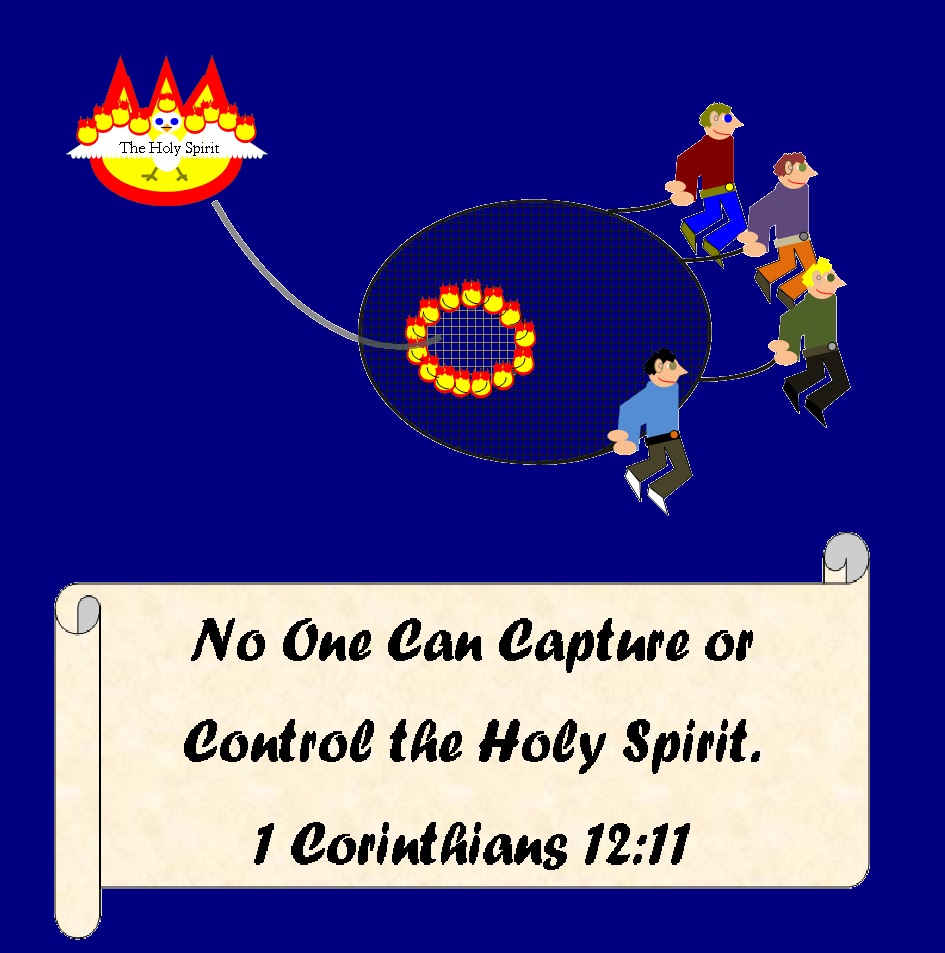
A major dispute among evangelical Christians is who has the Holy Spirit working in them. Scripture clearly teaches (2 Corinthians 3:18; Romans 8:9; John 7:39; Galatians 3:2-5) and implies (Philippians 2:13; Colossians 2:29; 2 Corinthians 3:5,6) that the Spirit works in all genuine believers. That is, those who have put their faith (Ephesians 2:8,9; Romans 4:4,5; Galatians 2:16) in Christ's death for them on the cross (1 Peter 2:24,25; Colossians 2:13,14; 2 Corinthians 5:21) for their salvation. Now we need to respond to this work of the Spirit in our lives (Galatians 5:16; Ephesians 5:18; 1 Thessalonians 5:19). But this is a process that happens over time (1 Corinthians 3:1-3; Hebrews 5:11-14; Ephesians 4:11-16) and involves effort (1 Timothy 4:7,8; Philippians 3:11-16; Hebrews 12:1-3). Now every church organization has marginal people, who are not living according to Biblical standards. The question is whether any group can claim the Holy Spirit is at work exclusively among them.
One of the things that is commonly seen as a mark of the Spirit's working is a specific experience. While Scripture calls us to put God's will before ours (Romans 12:1,2; 6:12-14; Matthew 16:24) and to renounce our sins (1 John 1:9; Proverbs 28:13; 2 Corinthians 7:10) and to trust in God's power rather than our own (Proverbs 3:5,6; Psalms 127;1,2; Ephesians 2:10), it does not prescribe a required experience. Rather, the Spirit of God intervenes in different ways in different contexts (1 Samuel 10:2-13; Acts 4:31; 13:9-12). Nor is the gift of tongues the sole sign of the Spirit's working in us, as we are not all to speak in tongues (1 Corinthians 12:27-30) and no gift is a proof of spirituality (1 Corinthians 13:1-3).
Now the chief means the Spirit uses to work in the lives of believers is the Word of God (2 Timothy 3:16,17; 4:1-4; Hebrews 4:12). Another means often classed with it is the sacraments . Certainly these ordinances are commanded of us (Matthew 28:19; 1 Corinthians 11:23-26; Acts 2:38). But does an individual's receiving the benefit of the sacraments depends on their belief regarding them or the method of administering them? Now if the correct understanding or exact mode of administering the ordinances were crucial to their validity, I would expect Scripture to spell it out, not leave it for us to infer. But while Scripture does speak against obvious abuses such as turning the Lord' Supper into a drunken feast (1 Corinthians 11:17-22), it does not specify the details. Now we should investigate these issues and follow what we conclude is the correct method. But I have a problem with basing the work of the Spirit on issues the Scripture does not categorically command.
I would therefore go back to my original conclusion that the Spirit is at work in all those who genuinely put their faith in Christ. And while we should all work to understand and obey God's commands, we are all still in the process of growing in Christ. And we need to approach our disagreements from that perspective.
Thursday, August 11, 2011
Tuesday, August 9, 2011
Exercising Authority
The ancient Christian church was assailed by many groups which claimed their new-found variations were better than traditional orthodoxy. To protect the ordinary Christian, the early leaders of the church came up with an idea to help. They pointed out that Jesus had taught the apostles, who had passed on His teaching to the leaders of the early church. Therefore, who are you going to believe, the church descended from the apostles or some upstart peddling a new doctrine? This reflects a degree of sense, as one argument to consider. But it grew into a magic talisman for determining correct teaching: the church descended from the apostles must always be right. Or take the split between the Roman Catholic and Eastern Orthodox churches. While there were issues involved, such as the date of Easter and the required degree of clerical celibacy, the real question was who was in charge. Or take the movement in the later half of the Middle Ages to reform the lax spiritual state of the church. It started out as an attempt to correct legitimate abuses (though I disagree with its endorsement of clerical celibacy). But it ended up in a pure power struggle with the civil authorities. As a result, the church authorities became more corrupt than the civil authorities they opposed. In fact, they had made themselves so unchallengeable that they prevented all moderate schemes of reform and only the Protestant Reformation was able to break their hold.
Now I have deliberately placed this discussion in the past to give it perspective, but even among Protestants who started out fighting this idea there can be a danger of relying on authority to settle issues rather than on the truth of Scripture. It is always easier to rely on being in charge and to uphold the way we have always done things rather than grapple with truth. I have never been a pastor, but I have been in church leadership positions for many years, and in my experience I am in an extremely dangerous position when I start worrying about my authority rather than what is right before God. That is not to say we should not be subject to those God has put over us (Hebrews 13:17; 1 Thessalonians 5:12,13; 1 Timothy 5:17). But once the issue becomes the leaders' authority, the discussion has already taken a wrong turn.
Monday, August 8, 2011
Friday, August 5, 2011
A Voice from the Past - Athanasius
As for the wisdom of the Greeks and the grandiloquence of the philosophers, I think that no one has need of any argument from us, as the miracle is before everyone's eyes that whereas these wise men among the Greeks have written so much, yet have been unable to persuade even a few from near-by places about immortality and lives of virtue, Christ alone by means of simple words and through men unskilled in speaking has persuaded crowded congregations of men throughout the whole world to despise death and think of things immortal, to turn away from things temporal and consider things eternal, to take no thought of earthly glory but only to seek immortality.
Athanasius, 295-373 AD, Concerning the Incarnation of the Son of God (De Incarnatione) 47:22-32 (translated by Robert W. Thomson, Oxford at the Clarendon Press, 1971, pp. 253, 255)
What do you think of this statement? Does it make sense? Does it still apply today?
Athanasius, 295-373 AD, Concerning the Incarnation of the Son of God (De Incarnatione) 47:22-32 (translated by Robert W. Thomson, Oxford at the Clarendon Press, 1971, pp. 253, 255)
What do you think of this statement? Does it make sense? Does it still apply today?
Thursday, August 4, 2011
The Backside of One God Too Many
One argument used by atheists is that their reason for not believing in the Christian God is the same as our reason for not believing in all the other gods. Therefore, if we just realized this we would become atheists. Now the assumption here is that we are basically naturalists who have tacked our belief in God onto our naturalism. But the question is, Are we? And should we be?
Now it is not surprising that Christians are influenced by naturalism. It is the underlying assumption in the classes we take, the shows we watch, and the books we read. It is, in fact, so pervasive in our culture it is difficult for us as Christians to weed it out of our lives. I am amused when I hear the claim that Christians hold to their beliefs because they are raised in them. In the United States if a person maintains a belief in a supernatural God into adulthood, they are going against the flow. The idea we can maintain someone in their Christianity by protecting them from all other ideas is futile.
But naturalism is unproved and unprovable. Just because there are orderly laws that govern the physical universe does not mean there is not Someone above the laws who can intervene if He chooses. It cannot even prove there are not beings mightier than us (for instance angels and demons) whose actions from our perspective would appear like magic. (There are also other problems with naturalism, such as where the universe came from and how life began.)
But do we as Christians see the world through naturalistic glasses? The reason Christians should reject other gods is not through a naturalistic aversion, but because we believe in the one true God and He forbids us to believe in the others. This does not mean there are not specific agreements against the other views. But if, having weighted the arguments pro and con for all the views (including naturalism), we conclude that Christianity is true, we are required to reject all other gods (Isaiah 43:10; 44:8; 1 Corinthians 8:5,6). But because we believe in only one God does not mean we should reject all other supernatural influence in the world. I am not saying that actual demonic beings appeared to individuals such as Mohammed and Joseph Smith, but I would not preclude the possibility. There are two opposite reasons for believing in only one God. You can believe that God is immensely great and powerful and the other beings called gods are meaningless and unnecessary in the presence of His majesty. Or you can want a God who is marginal and irrelevant. Who possibly started and superintends the universe and then leaves us to live our own lives. And compared to Him, the other gods are seen as too much. We as Christians need to honestly ask ourselves which God we believe in. Do we believe in the true and living God or a pale imitation?
Now it is not surprising that Christians are influenced by naturalism. It is the underlying assumption in the classes we take, the shows we watch, and the books we read. It is, in fact, so pervasive in our culture it is difficult for us as Christians to weed it out of our lives. I am amused when I hear the claim that Christians hold to their beliefs because they are raised in them. In the United States if a person maintains a belief in a supernatural God into adulthood, they are going against the flow. The idea we can maintain someone in their Christianity by protecting them from all other ideas is futile.
But naturalism is unproved and unprovable. Just because there are orderly laws that govern the physical universe does not mean there is not Someone above the laws who can intervene if He chooses. It cannot even prove there are not beings mightier than us (for instance angels and demons) whose actions from our perspective would appear like magic. (There are also other problems with naturalism, such as where the universe came from and how life began.)
But do we as Christians see the world through naturalistic glasses? The reason Christians should reject other gods is not through a naturalistic aversion, but because we believe in the one true God and He forbids us to believe in the others. This does not mean there are not specific agreements against the other views. But if, having weighted the arguments pro and con for all the views (including naturalism), we conclude that Christianity is true, we are required to reject all other gods (Isaiah 43:10; 44:8; 1 Corinthians 8:5,6). But because we believe in only one God does not mean we should reject all other supernatural influence in the world. I am not saying that actual demonic beings appeared to individuals such as Mohammed and Joseph Smith, but I would not preclude the possibility. There are two opposite reasons for believing in only one God. You can believe that God is immensely great and powerful and the other beings called gods are meaningless and unnecessary in the presence of His majesty. Or you can want a God who is marginal and irrelevant. Who possibly started and superintends the universe and then leaves us to live our own lives. And compared to Him, the other gods are seen as too much. We as Christians need to honestly ask ourselves which God we believe in. Do we believe in the true and living God or a pale imitation?
Tuesday, August 2, 2011
On Grace and Effort
How do grace and effort come together in the Christian life? Now in terms of salvation it is easy. We simply have faith (Romans 4:4,5; Ephesians 2:8,9; Galatians 2:16) in the work that Christ has done for us (1 Peter 2:24,25; Colossians 2:13-15; 2 Corinthians 5:21). But living the Christian life is more complicated. We want to avoid the idea that God has left us to do it alone, but we also want to avoid the idea it is easy or automatic and can be neglected. How do we put these two together?
It needs to be seen that grace undergirds the Christian life in a number of ways. It provides the motivation for us to live for God (1 John 4:19; 2 Corinthians 5:14,15; Luke 7:36-50). It also provides us with the power to do so (2 Corinthians 3:18; Philippians 2:13; Colossians 1:29). This means we can have confidence in God that He deals with us in grace (Romans 5:1,2; 8:31-34; Hebrews 4:16) and will ultimately lead us to victory (Romans 8:37; 2 Corinthians 2:14; 1 John 5:4,5). But it also forms a basis for humility in that we have not yet reached where we should be, but we press on toward it (Philippians 3:12-16; Galatians 5:16,17; 1 John 1:8-10), knowing we cannot stand before God based on our good works (Galatians 2:21; Romans 3:19,20; Philippians 3:9).
However, we are told that the result of salvation should be obedience to God (Titus 2:11-14; Romans 12:1,2; James 2:14-26). We are also told that this process requires practice and endurance (1 Timothy 4:7,8; Hebrews 5:12-14; 12:1-3). This many require obedience through hardship (John 16:33; Acts 14:22; 2 Corinthians 4:17,18), and may even, on occasion, involve God's discipline in our lives (Hebrews 12:5-11; 1 Corinthians 11:30-32; Revelation 3:19). Now there is a balance here. I do not believe that God calls us to live in an atmosphere of constant fear of His displeasure (Romans 8:15; 14:4; 1 John 4:18). Nor are we to take lightly the call of God to live a life in obedience to Him (1 Peter 1:14-16; Romans 6:12-14; 1 Corinthians 6:20). The Christian life involves finding the right perspective on these things so we are not cast down in despair or puffed up in self-righteousness.
It needs to be seen that grace undergirds the Christian life in a number of ways. It provides the motivation for us to live for God (1 John 4:19; 2 Corinthians 5:14,15; Luke 7:36-50). It also provides us with the power to do so (2 Corinthians 3:18; Philippians 2:13; Colossians 1:29). This means we can have confidence in God that He deals with us in grace (Romans 5:1,2; 8:31-34; Hebrews 4:16) and will ultimately lead us to victory (Romans 8:37; 2 Corinthians 2:14; 1 John 5:4,5). But it also forms a basis for humility in that we have not yet reached where we should be, but we press on toward it (Philippians 3:12-16; Galatians 5:16,17; 1 John 1:8-10), knowing we cannot stand before God based on our good works (Galatians 2:21; Romans 3:19,20; Philippians 3:9).
However, we are told that the result of salvation should be obedience to God (Titus 2:11-14; Romans 12:1,2; James 2:14-26). We are also told that this process requires practice and endurance (1 Timothy 4:7,8; Hebrews 5:12-14; 12:1-3). This many require obedience through hardship (John 16:33; Acts 14:22; 2 Corinthians 4:17,18), and may even, on occasion, involve God's discipline in our lives (Hebrews 12:5-11; 1 Corinthians 11:30-32; Revelation 3:19). Now there is a balance here. I do not believe that God calls us to live in an atmosphere of constant fear of His displeasure (Romans 8:15; 14:4; 1 John 4:18). Nor are we to take lightly the call of God to live a life in obedience to Him (1 Peter 1:14-16; Romans 6:12-14; 1 Corinthians 6:20). The Christian life involves finding the right perspective on these things so we are not cast down in despair or puffed up in self-righteousness.
Monday, August 1, 2011
A Touch of Humor - The Tourists
Can we expect the world to be built around us or for our convenience? How do we avoid this attitude?
Subscribe to:
Posts (Atom)